
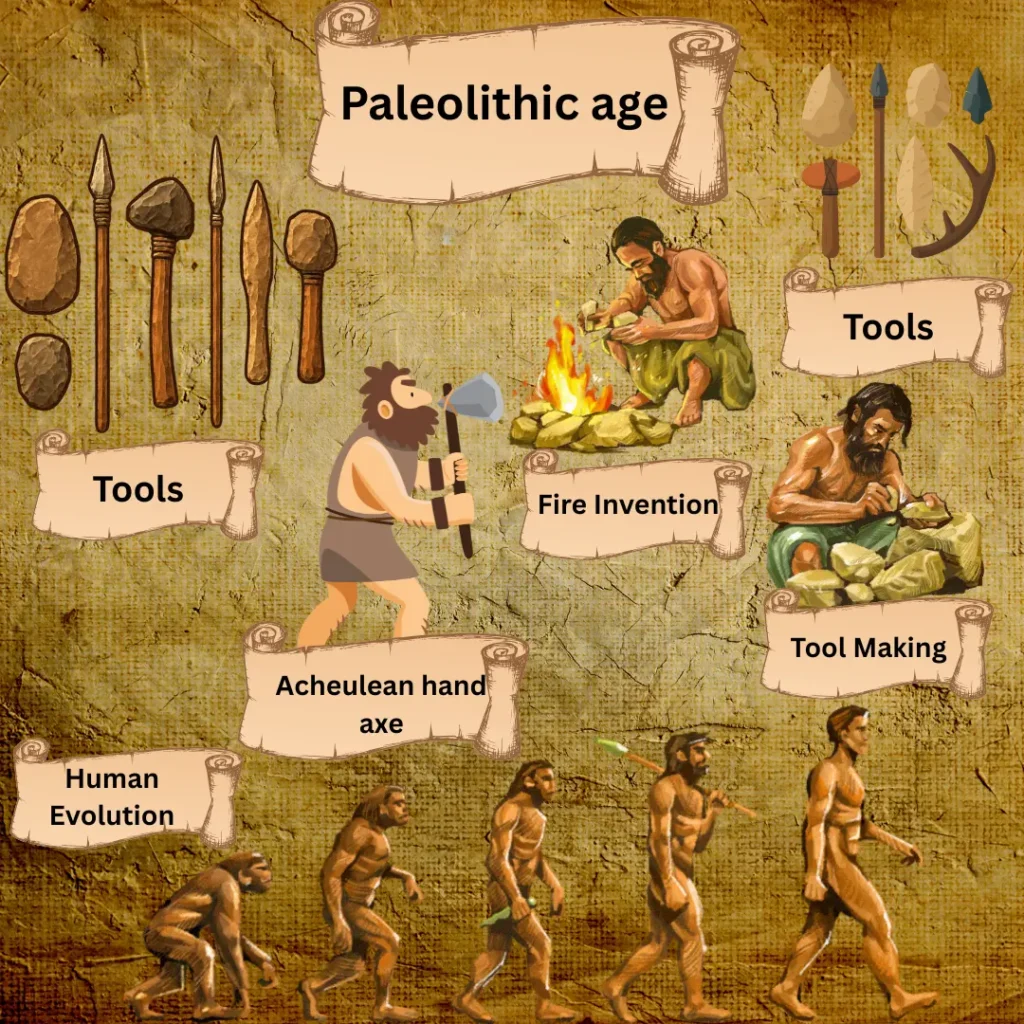
Looking at the modern world we are looking at a landscape of silicon chips, metropolises, and travelling around the globe. One can easily forget that human beings existed in the Paleolithic Age, 99% of our history. This is the historical period of the book of the history of mankind. The Paleolithic Age, which ran between approximately 2.5 million years ago and approximately 10,000 BCE, was a period of biology and culture-altering momentousness. This is the guide that we shall discover the way our forefathers survived the toughest climatic conditions, how they made the art of stone tool-making, and how they laid the foundation of all we can call civilisation today.
The Etymology of the Paleolithic Age
In order to get to the very bottom of our history, we have to consider first the linguistic system employed by scientists. Paleolithic The etymology of the term Paleolithic is palaios (old) and “lithos” (stone) in Greek.
The name was notoriously proposed in 1865 by the famous archeologist John Lubbock. Lubbock came to the realization in his masterpiece Pre-historic Times that the Stone Age was too large to be seen as an unbroken span of time. He applied the etymology of these Greek roots in order to differentiate between the Old period of chipped stone tools and the New period of polished stone and pottery. Such differentiation has been the foundation of archaeology in the present world.
The Stone Age in a Wide Perspective
The largest archaeological period is the Stone Age of the three-age system (Stone, Bronze, and Iron). It is an era characterized by a lack of metalworking and complete dependence on the natural materials.
Categorizing the Stone Age
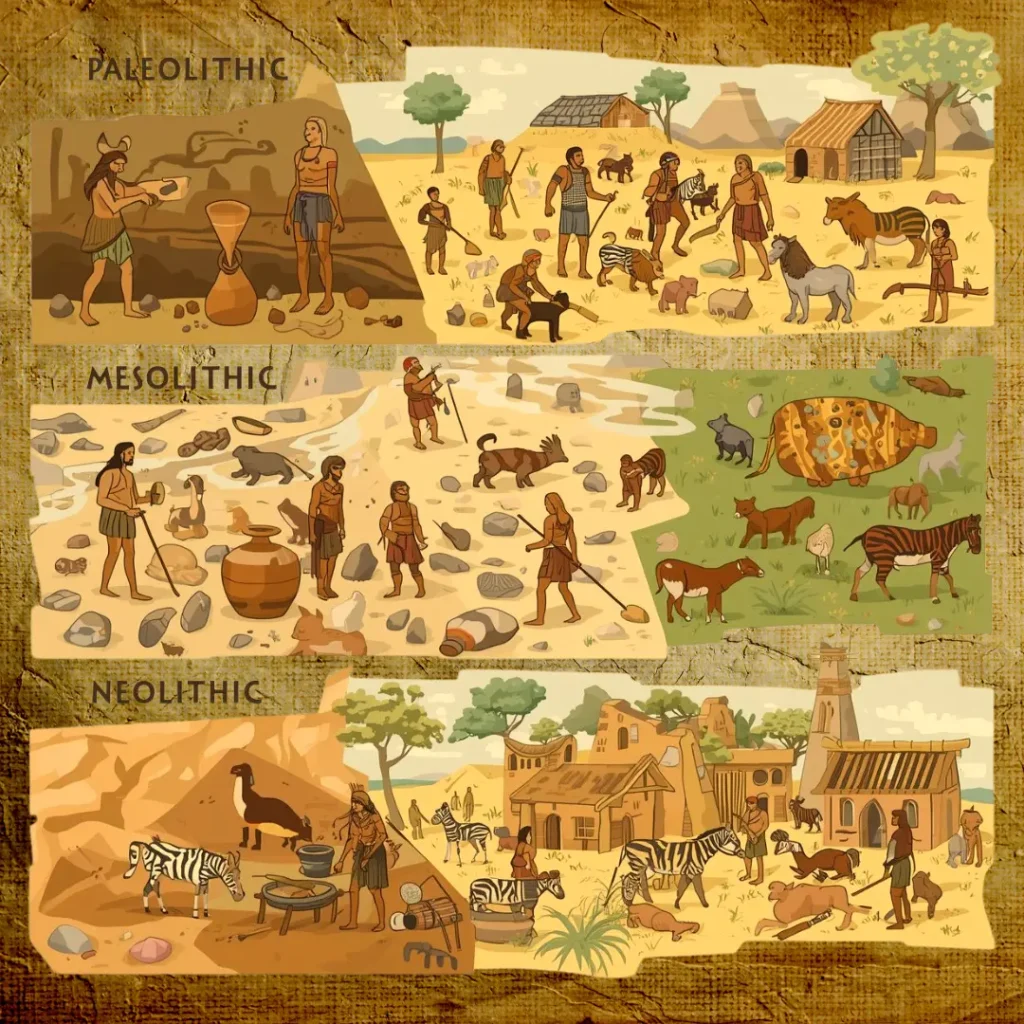
Historians subdivide the Stone Age into three phases to cope with a timeline as huge as this one:
The Paleolithic: The era of nomadic hunter-gatherers and the development of the genus Homo.
The Mesolithic: An intermediate period as man became more dietary diverse as he began more fishing and specialization in hunting as the glaciers thawed.
The Neolithic: The Agricultural Revolution, in which man settled in permanent villages and started domesticating plants and animals.
The Lower Paleolithic: Homo erectus Period
The history of the Paleolithic Age starts at the Pliocene-Pleistocene boundaries of Africa. Although the first tools were made during the era of early homo habilis and the first Oldowan, the Homo erectus was the one that transformed the human existence fully.
The Biology of Homo erectus
Homo erectus emerged, circa 1.9 million years ago, the first hominid to be human-like all the way down to the neck. They were on their feet, had a bigger brain capacity (average of 900cc), and were end endowed.
The Acheulean hand axe
This is an artifact that requires a great deal of time to master, yet once mastered, the skill allows an individual to make a living through crafting the tool and selling it to customers.
The Acheulean hand axe can be considered to be the flagship invention of the Paleolithic Age. In contrast to the primitive smashed rocks of the previous species, Homo erectus utilized a mental model to flake stones into teardrop shapes. This demanded vision, gnarled hands, and conveyance of complicated means to the new generation.
The Great Migration
The first global human being is Homo erectus. They were moved by this change in climatic conditions and the hunt after the game leaving Africa and coming to the Levant and later to the Caucasus (Georgia) and East Asia (China), and Southeast Asia (Java). This migration is one of the most important in the Stone Age confirming that human beings were already the most adaptable.
The Middle Paleolithic: Complicated and the Neanderthals
The Paleolithic Age is more human in its social complexity as we advance into the Middle Paleolithic (c.300000-50000 years ago). This is when the Neanderthals in Europe and the Near East and the early Homo sapiens in Africa are in pre-eminence.
The Mousterian Tradition of Toolmaking
The technology during this period changed from the use of heavy hand axes to the use of prepared core processes. This was done by carving a stone until one sharp flake would be struck off in a blow. This efficiency enabled the making of the spears and hunting became a different experience altogether.
Fire and Social Bonding
Although it is likely that Homo erectus discovered fire, the Middle Stone Age humans mastered it. Fire was the “social hearth.” It also lengthened the day and offered a time to tell stories and to cook stiff fibres and meats, which also helped a great deal in brain development.
The Upper Paleolithic: The Explosion of Creativity
The last phase of the Paleolithic Period (50,000 to 10,000 years ago) is widely referred to as the Creative Explosion. This is at the time of the attainment of behavioural modernity by Homo sapiens.
Innovation in Materials
Man ceased to deal with pure stone. They began utilizing:
Bone and Antler: Bone tools, including the first custom-made multi-layered garments necessary to survive the Ice Age.
Ivory: To be used in complex carvings and jewellery.
Clay: The earliest ceramic figures first started appearing.
Cave Art and Symbolic Thought
It is the time of the celebrated cave paintings at Lascaux and Chauvet. These bison, lion and horse pictures are not merely decorations. They are the dawn of religion, mythology and the desire of man to document our life.
Palaeolithic Geography and Regional Variations
The Palaeolithic Age was not everywhere the same. The lifestyle was determined by the environment.
The European Tundra
In Europe, people were dwelling in the shade of giant glaciers. They preyed on reindeer and mammoths and the caves were very important to them as they concealed themselves during the long winters.
The African Savanna
During the African Stone Age, a specialization was on various gathering and hunting of the grassland animals. The implements in this case were made quite variously and they took the shape of small but very efficient micro-liths.
The Asian Steppes
Homo erectus and subsequent populations in Asia used bamboo and other organic substances that are not well preserved in the archeological record. Nonetheless, their chipping instruments of stone or chopper-chopping are also a feature of the area.
Technical Mastery: The Development of Lithic Metal
The Paleolithic Era is characterised as a competition that was not between states rather between man and nature in terms of technological advancement. To learn about the Stone Age, it is necessary to know the physics of the so-called lithic reduction, the action of knapping stone to form a practical cutting edge. This technical change follows the evolution of the mental development of our forebears, the primitive opportunistic flakes to the precision blades of the Upper Paleolithic.
The Oldowan Industry: The first Blow
The Oldowan industry is the oldest tool-making technique that took place 2.5 million years ago. These were simple yet ground breaking tools. Procedures such as Homo habilis employed the hard hammer method and utilized one cobble to hit another one to create sharp-edged flakes.
The major instrument was the chopper, which was a stone worn by water, with a couple of flakes cut off to leave a jagged edge. Although the word technology is primitive by the modern standards, the etymology of the word technology originates here. These tools enabled human beings to reach the bone marrow that is high in fat and could not be reached by other scavengers thus fueling brain development that will result in the next advancement of evolution.
The Acheulean Revolution and the Homo Erectus
Homo erectus gave rise to some sort of symmetry in nature which had never been seen before and this was around 1.7 million years ago. This was an Acheulean industry. In contrast to the opportunistic method of the Oldowan method, the bifacial method was used by Homo erectus.
They carved on each side of a stone to produce the well-known Acheulean hand axe
This was done through soft hammer percussion. They did not strike the stone with another rock, but with wood, bone or an antler. This made it possible to remove thinner, flatter and sharper flakes. These axes are symmetrical and therefore give the impression that the Homo erectus had a mental template. They even imagined the finished tool in a piece of rock that was raw before they started.
The Technique of Levallois: Era of the Middle Stone Age
The Middle Stone Age was characterized by a change in tools to the core. The Levallois method (named after a suburb of Paris) is a giant step in abstract thought. Instead of merely whacking away till a tool emerged the knapper made a stone core into a shape resembling a turtle shell before preparing it.
One more, sure, crisp stroke struck a great, thin, and exceedingly sharp “predetermined flake” out of its place. Such a flake could then be hafted (attached) to a wooden shaft to develop the first real spears in the world. This enabled the Neanderthals and the primitive Homo sapiens to hunt dangerous animals in a distance without exposure to injury.
The Microlithic and the Blade Revolution
Towards the Upper Palaeolithic Age, tool-making was a professional craft. The Homo sapiens invented the indirect percussion. With a punch (of bone or antler) laid directly on the rock and a mallet used to hit the punch, they were able to create so-called blade flakes at least as long as they were wide.
These blades were the prehistoric industry blanks of the world. These might be folded into so-called “microliths” miniature and razor-sharp inserts that were inserted and formed harpoons, saws, and composite weapons. This efficiency resulted in the fact that a pound of flint could now cut even more than 30 feet of cutting edge compared to the previous 8 inches of cutting edge cut by the early Oldowan choppers.
A Palaeolithic Lifestyle: An In-depth Dissection
The part of the woman and the child
The myth of the Man the Hunter has been ruled out by modern research. During the Palaeolithic Age, up to 70% of the calories in the group were attained through the gathering work of women and children. The key botanists were women who were knowledgeable of which roots could be eaten and which could be used as medicine.
Health and Longevity
However, contrary to what most people think, the people of the Palaeolithic period were not always frail. Their illnesses were not among the illnesses of civilization, such as diabetes or heart disease. A surviving child could well look forward to living to their the 50s or 60s, assuming that he or she would not be injured or infected.
The Neolithic Revolution
It was not a war that brought the Paleolithic Age to its end, but a weather change. The world warmed as the Pleistocene Ice Age had given way to the Holocene. The so-called megafauna (mammoths and giant sloths) became extinct.
Humans had to change. They started to stay around the river, cultivate wild grasses in a better way and, at last, they planted the first seeds. This signaled the termination of the Stone Age as a nomadic period and the dawn of the modern world that we know about.
An overview of the Palaeolithic Timeline
| Period | Dates (Approx.) | Key Hominid | Tool Style |
| Lower Paleolithic | 2.5m – 300k BP | Homo erectus | Acheulean hand axe |
| Middle Paleolithic | 300k – 50k BP | Neanderthals | Mousterian Flakes |
| Upper Paleolithic | 50k–10k BP | Homo sapiens | Blades & Bone Tools |
Conclusion
The most formative period of our species is the Paleolithic Age. Even in the etymology of its name to the amazing migrations of Homo erectus, all elements in this epoch have been synonymous with the strength of the human spirit. We are the children of the people who lived through the Stone Age. It is through their story that we have an even greater appreciation of our story.