
When we open a history book, we aren’t just looking at a collection of old dates and dead kings. We are looking at a map of human experience. But if you ask a room full of scholars, “What is history?” you will get a dozen different answers. Some see it as a science, others as an art, and some as a weapon of the present.
For students and lifelong learners alike, understanding the meaning and definition of history is the first step in mastering the humanities. In this comprehensive guide, we will move beyond the surface-level facts to explore the philosophy, methodology, and profound relevance of history in the modern world.
1. History Meaning: The Linguistic Roots
To understand the history meaning, we must go back to the source. The word itself is derived from the Ancient Greek word historia.
In its original context, “historia” did not simply mean “the past.” It meant “inquiry” or “knowledge acquired by investigation.” When Herodotus, the “Father of History,” wrote his famous accounts in the 5th century BCE, he wasn’t just telling stories; he was investigating the causes of the Greco-Persian Wars.
In German, the word for history is Geschichte, which comes from geschehen, meaning “to happen.” This gives us a dual perspective:
- History as an Action: The act of investigating (Greek).
- History as an Event: The thing that happened (German).
The Distinction Between “The Past” and “History”
One of the most important lessons for any student is that “the past” and “history” are not the same thing.
- The Past: Everything that has ever happened since the beginning of time.
- History: The narrative or interpretation we create based on the evidence we find from the past.
As the historian John Lewis Gaddis notes in The Landscapes of History, history is like a map. A map is not the actual terrain; it is a representation of the terrain designed to help us navigate.
Measuring Time: Understanding BC/BCE and AD/CE
To navigate the “map” of history, we need a consistent way to mark time. Traditionally, Western history used a system based on religious milestones, but modern scholarship has shifted toward more inclusive terminology.
- BC (Before Christ) & AD (Anno Domini): This is the traditional Christian dating system. BC counts years backward from the estimated birth of Jesus Christ, while AD (Latin for “In the year of our Lord”) counts forward.
- BCE (Before Common Era) & CE (Common Era): These are the modern, secular equivalents now preferred in academic and global contexts. They use the exact same numerical timeline as BC/AD but use religiously neutral language.
The “Countdown” Logic
One of the most confusing aspects for new students is that in the BC/BCE era, years count backward. For example, 500 BCE happened before 200 BCE. Think of it like a number line where the “Common Era” begins at year 1; the further you go into the past, the higher the number becomes.
Summary Table: Chronological Terms
| Term | Full Meaning | Usage |
| BC | Before Christ | Traditional; used for years before Year 1. |
| BCE | Before Common Era | Modern/Academic; equivalent to BC. |
| AD | Anno Domini | Traditional; used for years from Year 1 to today. |
| CE | Common Era | Modern/Academic; equivalent to AD. |
2. The Meaning and Definition of History: Perspectives from the Masters
If you are looking for a singular definition of history, you won’t find one that satisfies everyone. Instead, we look to the “Masters” of the craft, historians whose books have defined the discipline.
E.H. Carr: The Unending Dialogue
In his seminal book, What is History?, E.H. Carr provided perhaps the most famous definition in the English language:
“History is a continuous process of interaction between the historian and his facts, an unending dialogue between the present and the past.”
Carr argued that history is never objective. The historian chooses which facts are “important” based on their own biases and the needs of their society at the time. Therefore, history is a living thing that changes as we change.
R.G. Collingwood: The Re-enactment of Thought
In The Idea of History, R.G. Collingwood took a more psychological approach. He argued that the definition of history is “the re-enactment of past thought in the historian’s own mind.” To Collingwood, knowing what happened isn’t enough; we must understand why the person thought it was a good idea to do it. History is the study of the human mind and action.
Marc Bloch: The Science of Men in Time
The French historian Marc Bloch, co-founder of the influential Annales School, defined history in The Historian’s Craft as “the science of men in time.” He believed that the historian’s job is to understand how people lived, thought, and felt within the specific context of their era, rather than judging them by modern standards.
Summary Table of Historical Definitions
| Historian | Book | Key Definition / Concept |
| Herodotus | The Histories | History as an “inquiry” into causes. |
| E.H. Carr | What is history? | An “unending dialogue” between past and present. |
| R.G. Collingwood | The Idea of History | “Re-enactment” of past thoughts. |
| Marc Bloch | The Historian’s Craft | The “science of men in time.” |
| Arnold Toynbee | A Study of History | History is the rise and fall of civilizations. |
3. Why is History Important?
You might hear people say, “Why bother with the past? We need to focus on the future.” But this is a fundamental misunderstanding. The question “Why is history important?” can be answered through four critical pillars.
A. It Provides Identity
We cannot know who we are if we don’t know where we came from. This applies to individuals (genealogy), communities (cultural heritage), and nations (national identity). History tells us the “story of us. “Without it, we are like an amnesiac waking up in a strange room. We have no context for our own existence.
B. It Is a “Laboratory” for Human Behavior
We cannot perform experiments on entire societies in a lab. However, history provides us with thousands of years of “data.” By studying the past, we can see how people respond to pandemics, economic crashes, or political revolutions. In this sense, history is the most practical subject there is.
C. The Lessons of the Past
As George Santayana famously wrote in The Life of Reason, “Those who cannot remember the past are condemned to repeat it.” While history doesn’t repeat itself exactly, it certainly rhymes. Studying the failures of the League of Nations helps us understand the challenges of the United Nations today.
D. Developing Critical Thinking
The study of history requires us to evaluate conflicting evidence. When two primary sources disagree on the details of a battle, the student must analyze bias, intent, and reliability. This skill the ability to sift through information to find the truth is more important now than ever in the age of “post-truth” and digital misinformation.
4. The Historian’s Toolkit: How History is Constructed
How do we move from the definition of history to the doing of history? This involves a rigorous methodology.
Primary vs. Secondary Sources
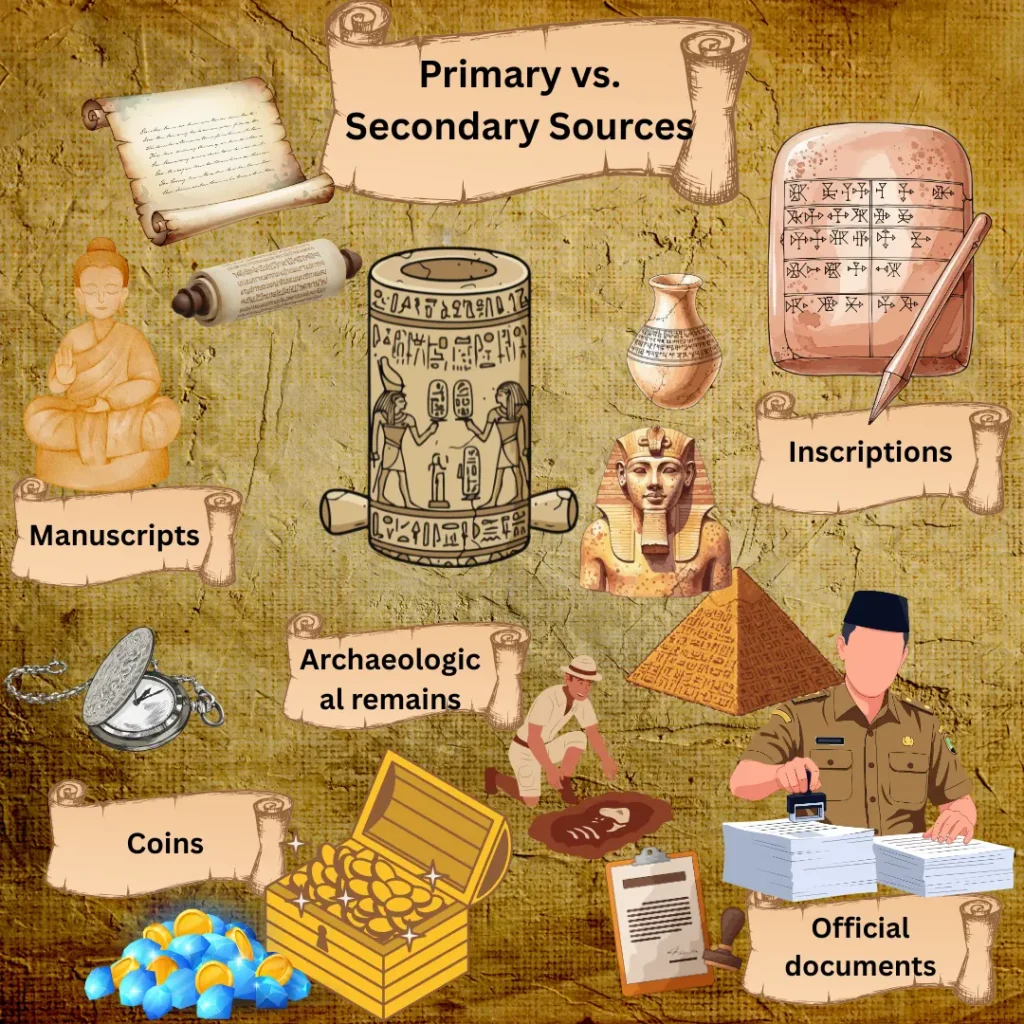
- Primary Sources: These are the “raw materials” of history. They are original documents or objects created at the time of the event.
- Examples: Diaries, letters, government records, photographs, buildings, and oral testimonies.
- Secondary Sources: These are interpretations of the past written by someone who did not witness the events first-hand.
- Examples: Textbooks, biographies, and journal articles.
The Problem of Objectivity
Can history ever be 100% objective? Most modern historians say no. Because every historian is a product of their time, their choice of topic and their interpretation of facts will always be subjective. However, the method must remain scientific. A historian must be honest with the evidence, even if it contradicts their preferred narrative.
5. The Diverse Branches of History
History is a massive umbrella. Depending on what you are interested in, you might specialize in one of several branches.
| Branch | Focus Area |
| Political History | The study of power, leaders, laws, and government structures. |
| Social History | The “history from below” focusing on ordinary people, women, and marginalized groups. |
| Economic History | How people traded, worked, and managed resources (from bartering to Bitcoin). |
| Cultural History | The evolution of ideas, art, religion, and social customs. |
| Military History | The study of armed conflict, strategy, and its impact on society. |
| Environmental History | The relationship between humans and the natural world over time. |
6. Historiography: The History of History
To truly master the topic, one must understand Historiography. This is the study of how historical writing has changed over time.
For centuries, history was written as a story of “Great Men”, kings and generals. In the 20th century, however, the focus shifted toward “Social History,” looking at the lives of the working class and women. Today, we are seeing a rise in “Global History,” which tries to look at how different parts of the world influenced each other, rather than focusing only on Europe or America.
Conclusion: Becoming a Part of the Dialogue
So, what is history? It is an investigation into the human soul across the span of time. It is a definition of who we were, an explanation of who we are, and a guide for who we might become.
When we understand the meaning and definition of history, we stop seeing the past as a collection of dead facts. Instead, we see it as a vibrant, ongoing conversation that we are all a part of. Every choice you make today is a fact of tomorrow’s history.